„Sell-off“ in the technology sector supports cyclical market segments
The apparent calm on the stock markets is deceptive. Although the global stock market recorded a slight increase in February, the US stock market was once again downgraded relative to Europe and emerging markets. At the same time, the rotation away from highly valued technology stocks toward cyclical value stocks and defensive sectors such as healthcare and consumer staples continued.

Dr. Matthias Ramser
- Despite declining market capitalization in the tech sector, indices remain stable
- Energy and emerging market stocks benefit
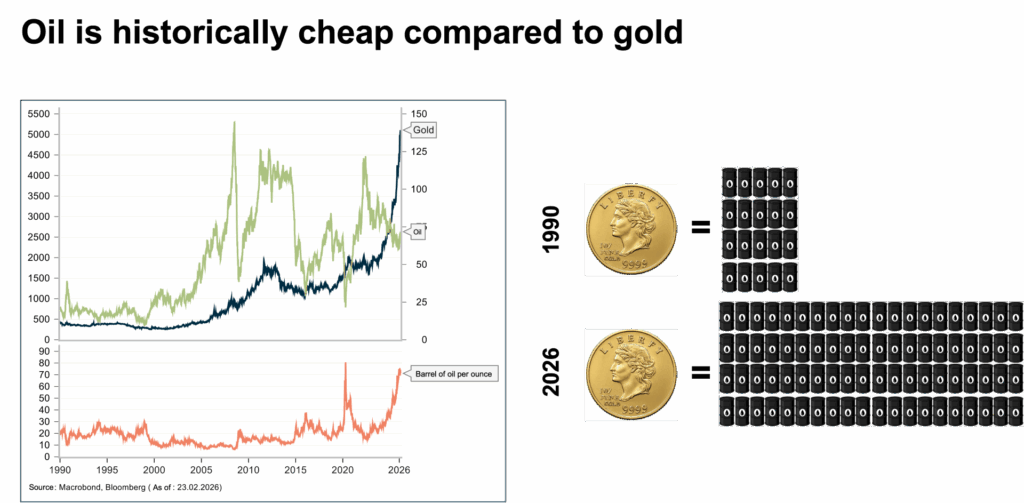
- Historically high gold/oil ratio indicates oil is undervalued
AI: Productivity or disruption?
Anthropic’s AI update, published at the beginning of the month, led to noticeable price declines, particularly in the areas of software, cybersecurity, and IT services. There is increasing speculation in the market that AI will take over fundamental tasks that were previously performed by traditional software providers, IT service providers, and security companies. Even though there are potential beneficiaries of productivity gains within these industries, the narrative of disruption currently dominates. Against this backdrop, we advise against making hasty purchases.
Investor nervousness is exemplified by Microsoft’s share price performance: since the beginning of the year, its market capitalization has fallen by around USD 1,200 billion – an amount equivalent to the capitalization of the entire Italian or Spanish stock market. We see similar concerns in parts of the financial sector as well as in legal services and consulting. On the other hand, energy and commodities, industry, and pharmaceuticals, including biotechnology, appear to be less affected or structurally favored.
The good news is that the sell-off in the technology sector has not yet led to broad index declines. Instead, the funds released have been shifted to more cyclical market segments and increasingly to emerging markets, which have recently benefited from improved economic signals. We expect this sector rotation to continue.
US politics remain a source of uncertainty, US dollar still under pressure
The nomination of Kevin Warsh as Jerome Powell’s successor at the helm of the Fed can be seen as a sign of institutional continuity and independence for the US central bank. Warsh is considered a proven monetary policy expert and previously worked at the Fed under Ben Bernanke. We expect him to continue on the path of interest rate cuts. According to his statements to date, he considers this to be justified, as AI-driven productivity gains tend to have a deflationary effect.
In the past, Warsh has also advocated a significant reduction in the Fed’s balance sheet. However, this would only be possible in close coordination with the Treasury under US Treasury Secretary Scott Bessent. Given the current political environment, such coordination appears challenging. Accordingly, we expect the US dollar to remain under pressure, particularly against hard currencies such as the CHF and commodity-linked currencies such as the Canadian or Australian dollar.
The US Supreme Court ruling that the Trump administration’s tariffs imposed on the basis of emergency law were illegal has once again triggered uncertainty in international trade. However, it also underscores that the separation of powers in the US is still functioning. The temporary tariffs of 15 percent, which were announced immediately, will apply for 150 days and then require the approval of Congress, but they will increase trade policy uncertainty in the short term.
In the medium term, however, we expect the effective tariff level to be lower than the rates currently under discussion. This would be fundamentally positive for global growth, with China, India, and Brazil likely to benefit in particular. At the same time, however, we also see risks of rising long-term US interest rates and continued pressure on the USD.
Geopolitical tensions between the US and Iran are rising – energy stocks are benefiting
Tensions between the US and Iran have increased significantly, and further military escalation cannot be ruled out. Although we do not expect any lasting impact on the global economy, we do anticipate increased short-term volatility.
Against this backdrop, now seems like a good time to build up exposure to energy stocks alongside gold and industrial metals. These are strategically well positioned. The structural commodity supercycle – characterized by supply bottlenecks following years of underinvestment and robust global demand as a result of reindustrialization and electrification – is also creating a solid fundamental foundation for energy prices.
Notable value ratio of gold to oil
The price of oil has lagged significantly behind gold in relative terms. This historically high gold/oil ratio indicates that oil is relatively undervalued. While gold remains in demand as a structural hedge against US dollar debasement and high government debt, the price of oil reflects cyclical risks rather than actual supply shortages.
Following the sharp rise in gold prices, disciplined rebalancing therefore appears sensible. Partial profits can be shifted into other commodity stocks, particularly energy stocks. These offer attractive valuations, robust free cash flows and dividend yields, as well as an additional geopolitical hedge: rising risk premiums in the oil market in the event of an escalation with Iran would have an immediate positive impact on energy companies.