France’s debt trap: the next stress test for the euro
The financial markets usually only take an interest in sovereign debt when it is already too late. For years, deficits can grow, reforms can be delayed and debt can accumulate without investors reacting. But at some point, perceptions shift. Then the focus is no longer on the causes, but on the cost of financing. France is approaching such a point.

Christof Reichmuth
- Interest burden is eating into growth
- Investors pay the price through euro depreciation and loss of purchasing power
- Real assets: combining quality and stability
Whilst public attention is often focused on the US, one of Europe’s greatest fiscal challenges lies right at the heart of the eurozone. French public debt now stands at around 119 per cent of gross domestic product. This places the country well above the threshold beyond which debt dynamics can become critical.
A debt trap rather than growth momentum
What matters here is not so much the absolute level of debt as the relationship between economic growth and financing costs. If debt exceeds 100 per cent of gross national product, the state can only grow out of its debt if nominal growth exceeds nominal interest rates. And that is not currently the case in France. The interest burden is eating into growth. Should this persist, the debt dynamics will begin to feed on themselves, leading to a classic debt trap. It is precisely this risk that is emerging in France.
This is clearly evident in the bond markets. Whilst, up until the global financial crisis, investors viewed France in virtually the same light as Germany, the picture has changed fundamentally. Between 2015 and 2024, the yield spread between ten-year French and German government bonds was mostly below fifty basis points. France was regarded as a core member of the eurozone. Today, the situation is different. The risk premium is once again moving towards levels last seen during the euro debt crisis. The market is increasingly no longer viewing France as a core country, but rather as a kind of ‘semi-core’ issuer.
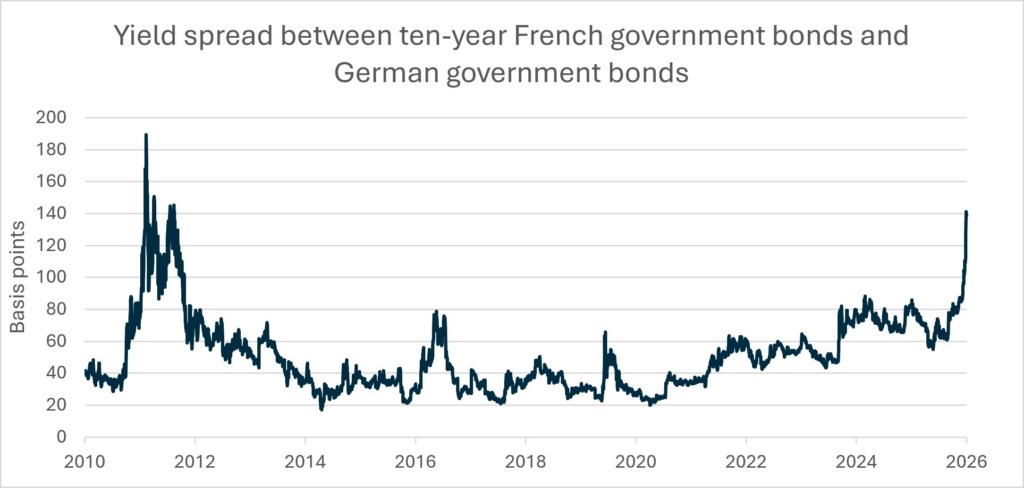
The situation is made more problematic by the general rise in interest rates. During the euro crisis and in the years that followed, German interest rates were at times close to zero. Today, ten-year German government bonds yield significantly more. France is therefore not only paying a higher risk premium, but is also starting from a significantly higher base. And even more important is the scale of the issue. Greece was at the centre of the euro crisis because its public finances had spiralled out of control. France, however, is around ten times more significant economically than Greece. A scenario in which France could lose access to the capital markets would therefore be unthinkable for Europe.
This is precisely why the financial markets assume that the European Central Bank would intervene again in an emergency. We share this expectation. The ECB now has instruments at its disposal with which it can prevent the fragmentation of the bond markets. The likelihood of a classic sovereign default therefore appears low.
Loss of purchasing power: investors will ultimately foot the bill
Whether investors will escape unscathed remains highly questionable, however. Historically, high levels of public debt have rarely been reduced through defaults. More often, relief has come through financial repression, higher inflation or a creeping devaluation of the currency. The actual adjustment does not take place via the face value of the debt, but via its purchasing power.
For the eurozone, this means that, in the long term, fiscal tensions are likely to affect the exchange rate rather than the solvency of individual states. The more monetary policy is forced to accommodate fiscal problems, the greater the pressure on the single currency. The euro is thus once again facing its structural dilemma. On the one hand, highly indebted Member States must remain financially viable. On the other hand, the stability of the currency suffers when monetary policy is increasingly subordinated to fiscal requirements.
The burden of ‘weak currencies’
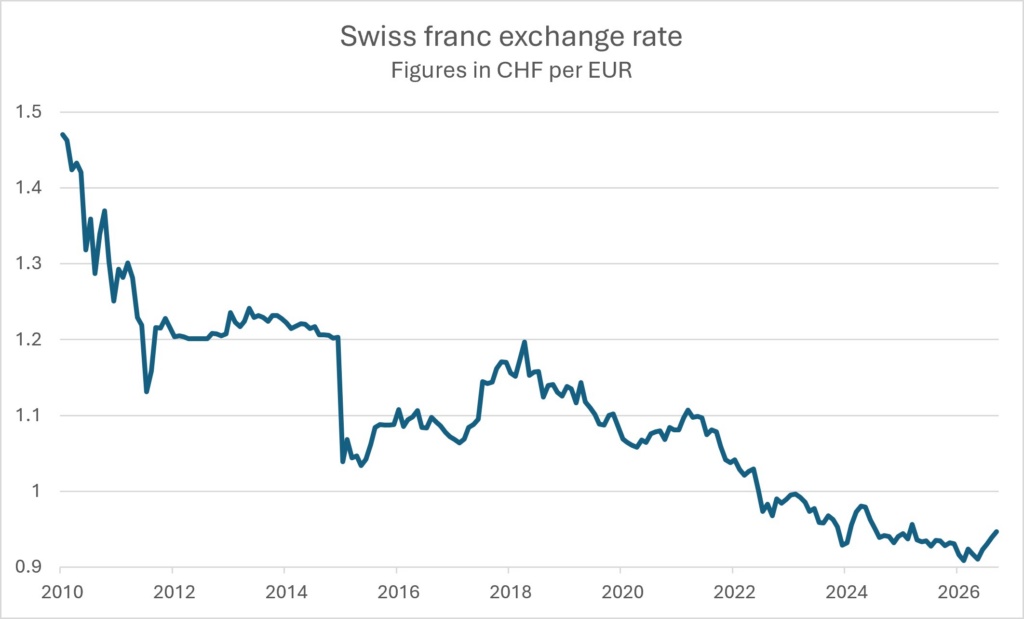
From an investor’s perspective, this has a clear implication. Nominal investments in heavily indebted countries do not offer an attractive risk-reward ratio. Even if the ECB prevents major disruptions, there is a risk of real economic losses through inflation or currency depreciation. This is also evident from the trend in the exchange rate between the euro and the Swiss franc. In parallel with the rise in bond spreads, the euro exchange rate has recently fallen sharply.
Focus on ‘Real Assets’
We therefore continue to advise against holding long-term French government bonds. Those who are confident in Europe’s economic future will find more attractive opportunities in productive real assets, high-quality companies with an international presence, or real assets denominated in stable currencies and markets. For the crucial question is: who will ultimately foot the bill for a failure to implement fiscal adjustment? The history of public finances provides a clear answer: in the end, it is almost always the creditors and the holders of the currency.